Pages

22 April 2014

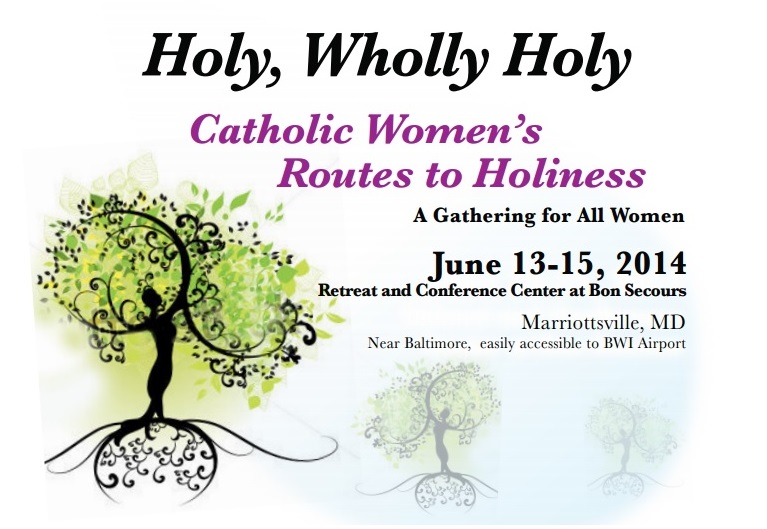
Women of Dignity/WATER Retreat June 13-15, 2014

Holy Wholly Holy 3
The Women of DignityUSA and Women’s Alliance for Theology, Ethics and Ritual
(WATER) team up for a third retreat led by lesbian and queer women. This year we
will focus on holiness, sainthood—our own and other’s—and how we get there. The
weekend will include prayer, quiet, recreation, celebration, and conversation.
Women saints will guide our way. Wholly holy women will emerge.
Our weekend will run from 6:00 PM Friday when we gather for dinner through the conclusion of lunch on Sunday at 1:00 PM. The fee includes six meals, snacks,
beverages and all costs associated with participation in the retreat. There are both
commuter and residential rates. All sleeping rooms have double beds and private baths.
The Retreat and Conference Center has plenty of parking for those choosing to
drive. For those who will travel by train or plane, we will provide information on
ground transportation from BWI airport along with your registration confirmation.
For more information contact info@dignityusa.org or waterstaff@hers.com

Holy Wholly Holy 3

11 April 2014

May 13 Teleconference with Cynthia Tootle

OLYMPUS DIGITAL CAMERA
WATER's Feminist Conversations in Religion Series Presents
"Greeting the Goddess"
An hour-long teleconference with
Cynthia Tootle
Tuesday, May 13, 2014
1 pm - 2 pm EDT
Cynthia Lea Tootle is an ordained Interfaith Minister. She studied at the All Faiths Seminary International. She serves currently as an associate minister of the Takoma Park Metaphysical Chapel. Her ministry includes monthly services that honor the Goddess in innovative rituals. Cynthia uses her creativity to develop services and classes that introduce people to many kinds of spiritual practices that open people up to intuitions and spiritual energies.
Cynthia retired after 35 years of working as a civilian engineer and technical manager for the US Department of Army. She has a B.S. in Applied Mathematics from the University of Michigan, College of Engineering, and an M.S. in Management Science from Fairleigh Dickinson University.
The Rev. Tootle lives in Silver Spring, Maryland, filling her spare time with gardening, Yoga, Qi Gong, and making quilts for children in need.
Suggested Reading:Dialogue with the Goddess (CreateSpace Independent Publishing Platform, 2012). Available in paperback and kindle edition from Amazon.
Mary E. Hunt wrote of the book:"Cynthia Tootle offers a prayer book, a wise guide, a conversation, and beautiful images to nurture relationships with the Goddess in Her many splendors. Savor this offering with all of the richness it entails. You, too, can be among Her loves."
          Email "Register Me Teleconference" towaterstaff@hers.com by Monday, May 12, 2014 in order to receive dial-in information.

Déjà vu All Over Again on Contraception

MaryHuntbio (1)Originally posted for Feminist Studies in Religion 
I was in front of the Supreme Court on March 25, 2014, on a snowy spring morning when the justices heard oral arguments for the Sebelius v. Hobby Lobby case about the provision of birth control as part of health care. Maybe it was the miserable weather with wet snow flakes the size of silver dollars that made me wonder what we were doing in 2014 lining up on two sides of a one-dimensional issue. Democracy demands patience, but enough already when it comes to women’s bodies.
Contraception seemed to be settled ethics, if not settled law, until the Patient Protection and Affordable Care Act, what some call Obamacare, came along. Stung by its very passage in 2010, opponents have focused on contraceptive coverage as a way to whittle away at the new plan. Ironically, it has proved to be more popular than skeptics expected. Millions of previously uninsured people, including young folks who can stay on their parents’ insurance until age 26, benefit from provisions of the law. But for those who would prefer that the government not be involved in health care even if it means millions would be underserved, birth control is their issue of choice, all puns intended.
Birth control seems so last century. Didn’t our mothers and grandmothers struggle for affordable, effective contraception? Isn’t it part of routine health care, standard of practice, for all women of childbearing age? If so, why is it even up for discussion, much less litigation, when it comes to a law that applies to everyone? No one seems concerned about the removal of an appendix so why sweat birth control when it is part of normal insurance coverage?
In two cases before it, the Supreme Court will decide if private companies can plead religious scruples about covering this basic health care for women. The matter of corporations being religious remains opaque—I’ve never seen one receive communion or fast during Ramadan. What concerns me is the backpedaling on women: clearly women’s bodies are somehow beyond the pale, not normatively human, subject to discussion when it comes to health care. I think not.
Fortunately, there are religious resources this time around to counter the conservative narrative. And there are women religious leaders who prioritize this matter even when some of their usually outspoken male counterparts have apparently taken a vow of silence on the issue. The Religious Institute, “a multifaith organization dedicated to advocating for sexual health, education, and justice in faith communities and society” issued a statement signed by dozens of religious leaders in support of “contraceptive access for all.” Catholics for Choice and many other groups (including WATER) filed an amicus brief arguing that “people of faith support contraceptive access and true religious liberty for all.” The Religious Coalition for Reproductive Choice, made up of several dozen groups, takes a strong stand for access to contraception, including Emergency Contraception.
These groups, along with the Unitarian Universalist Association, the United Church of Christ, National Council of Jewish Women, and the Methodist Federation for Social Action, co-sponsored an interfaith worship service and procession to the Supreme Court on the snowy day as a way to articulate faith that includes women’s well being. Speaker after speaker made cogent cases for why conscience matters, how we live religious diversity, why women’s health and especially family planning are so important, and what religious liberty means and doesn’t.
Other religious groups, including the U.S. Conference of Catholics Bishops, rallied by the Becket Fund turn the religious liberty issue on its head. To insist on the religious right to limit women’s choices by refusing to abide by the new health care laws is an odd, not to say pernicious, claim. One might be persuaded that religious liberty were at stake if the question were blood transfusions, but when it comes to contraception there is little doubt that control of women is the primary motivation.
I have often wanted to say that my faith constrains me when it comes to paying for war, the death penalty, and ecological destruction. But in a democracy one makes certain concessions and finds ways to counter the worst impacts of things with which one disagrees. But apparently women’s autonomy, women’s bodies, women’s choices, women’s moral agency, and women’s well being do not warrant such respect by many people. Is it déjà vu or were we naïve to think that anything every changed at all?
I expect to be in front of the Supreme Court on what will probably be a scorching summer day in 2014 when the Supreme Court will reveal its verdict. Signs will wave: “We are the 99% of Catholic women who use birth control”; “If men could get pregnant birth control would be sold in gum ball machines and be bacon flavored.” I will not mind the heat any more than the snow. But I will be extremely disappointed if my intern colleagues and my teenage daughter have to struggle for basic health care coverage ever again.

10 April 2014

May 11 Discussion with Victoria Rue

victoria rue
WATER invites you for a discussion on
"Lesbian Queer
Catholic Married Priest -
So What?"
Led by Victoria Rue
Sunday, May 11, 2014
at 11:30AM EDT
Victoria Rue is a professor at San Jose State University in Comparative Religious Studies and Women's Studies. She has a Masters of Divinity from Union Theological Seminary in New York City and a Ph.D from the Graduate Theological Union in Berkeley, CA. She is a theatre writer and director. As a Roman Catholic woman priest she helped to establish three faith communities in the northern California Bay Area.Victoria has published numerous articles, including "This Is My Body" in New Feminist Christianity: Many Voices Many Views, edited by Mary E. Hunt & Diann L. Neu, 2010. Victoria's book, Acting Religious: Theatre as Pedagogy in Religious Studies, was published by Pilgrim Press. In January l988, Victoria was called forth by Dignity NYC to con-celebrate a Mass with an out gay priest on 5th Avenue, across from St. Patrick's Cathedral. In l995 in Oakland, California, she co-founded A Critical Mass: Women Celebrating the Eucharist. In 2005, she was one of four women ordained as priests on a boat on the St. Lawrence Seaway. Victoria and her partner Kathryn Poethig, M.Div., Ph.D., met at Union Theological Seminary. Kathryn is a candidate for ordination in the Presbyterian Church, and is Associate Professor Global Studies at California State University at Monterey Bay. They celebrated their twentieth anniversary of commitment in September 2008 by getting married. For more on Victoria, see her website: http://www.victoriarue.com.
Please reply to waterstaff@hers.com with the words “Catholic Lesbian/Queer Women's Discussion” by Friday, May 9, 2014, to receive the phone-in information and a short piece by Victoria on the topic. Then dial in from 11:30 AM until 12:30 PM on Sunday the 11th for what is sure to be a thoughtful conversation.
While other WATER conversations are open to a wider audience, this one is intended for women who are interested in same-sex love from a Catholic lesbian/queer perspective. Please spread the word.
The next conversation will be on Sunday, July 13, 2014 at 11:30 AM EDT.

08 April 2014

Happy Spring from WATER!

It's springtime! Are you ready for renewal and rebirth? We are!
Blossom (1)
Thanks to your support and generosity, WATER is full of life.
After a long winter, spring has come! There are many buds to show for it – rituals, programs, publications, lectures, and collaborations galore. We've been working non-stop and feeling involved and invigorated. Join in!
Did you catch our recent teleconferences with Anne E. Patrick, Jamie Manson, or Margaret Mann? What about contemplative prayer with Hope Bauerlin or Janet Bohren? No? Never fear! Teleconference and contemplative prayer audios, notes, and more upcoming programs are posted on our website for your convenience!
Did you see Mary and Cathy's tribute to Kaye Ashe (¡Presente!) in the National Catholic Reporter? Check it out here!
Your donations support all of these resources, Summer Interns, and more! Come join the party for a feel-good spring, and donate to WATER today!
You put a spring in our step. You are a vital part of this global community. Together, we use feminist religious values to bring about much-needed social change.
We wish you a full and vibrant spring, and plenty of time to stop and smell the flowers!
With Blessings of Spring,
Mary Signature 2011          Diann Signature 2011           Cathy Jaskey Signature Final
Mary E. Hunt            Diann L. Neu                 Cathy Jaskey

18 March 2014

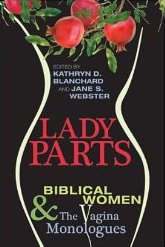
Learning from "Lady Parts" By Mary E. Hunt

Teachers need vivid imaginations to keep students interested and materials fresh. Kathryn D. Blanchard and Jane S. Webster demonstrate creative pedagogy and innovative scholarship with Lady Parts: Biblical Women and the Vagina Monologues (Eugene, OR: WIPF and STOCK, 2012). This is a unique project both in content and method. It is bound to generate others like it and, with luck, change lives. Various women from Hebrew and Christian scriptures are brought alive by 21st century scholars, students, and others.
The texts of Lady Parts are hard to read. It is not because they are poorly written, nor because they are uninteresting. To the contrary, I found them painful. Stories of ripped, torn, abused, bloodied, mistreated, ignored vaginas are not easy to read. I hope they never become so, because a major goal of the book, according to the authors, is to stop violence against women. One cannot stop something one does not know about.
Most people turn to the sacred scriptures of their faith with the hope of finding insight, enlightenment, even encouragement. Alas, what shines through here is the way in which women, Christian and Jewish among others, have been mistreated for millennia: violated, raped, used, objectified, and thrown away for newer models. Admittedly, the Lady Parts stories, based on scripture, were written by late modern women whose own experiences and awareness lie behind the telling. But I was left to wonder if there is no lovely text in Hebrew and/or Christian scripture where the vagina is enjoying her dear self, safe and snug in her woman’s place, ready for the pleasure for which she was created. Apparently there is not. Gender oppression is ubiquitous and there is no reason to think scriptures would be exempt.
I was heartened to find a few lesbian scenes in the texts. I detect that the roots of Dolly Van Fossan’s piece, “Eve,” in Lady Parts may be in Judith Plaskow’s famous myth about Lilith. Dolly makes the women’s relationship explicit, stretching our imaginations to encompass a new possibility in the text. This is a welcome advance in the 21st century for which Dr. Plaskow’s extraordinary creativity forty years earlier prepared the way.
That Eve and Lilith enjoyed themselves now seems to be an obvious interpretation. I went back to Judith Plaskow’s classic, The Coming of Lilith: Essays on Feminism, Judaism, and Sexual Ethics (Boston: Beacon Press, 2005, especially pages 31-32 where the original myth is reprinted), looking for hints and glimpses that only a lesbian hermeneutic would reveal. There they were, though I had all but missed them in many readings.
Read the text: “before Lilith got away, Eve got a glimpse of her and saw she was a woman like herself…Another woman! The very idea attracted Eve. She had never seen another creature like herself before. And how beautiful and strong Lilith looked!” So Eve noticed the other woman. That was a good sign.
Later in the text: “One day, after many months of strange and disturbing thoughts, Eve wandering around the edges of the garden…swung herself over the wall. She did not wander long on the other side before she met the one she had come to find, for Lilith was waiting.” So, apparently it was a two-way street. Lilith was also interested. Nice.
Their conversation ensued: “They taught each other many things, and told each other stories, and laughed together, and cried, over and over, till the bond of sisterhood grew between them.” What a nice way to describe their pleasurable times together. How had I missed it before?
Toward the end the text reads: “And God and Adam were expectant and afraid the day Eve and Lilith returned to the garden bursting with possibilities, ready to rebuild together.” It sounds like the afterglow of a very special time to me. The males had reason to worry because they were both unnecessary to the women’s pleasure and a source of distraction from the women’s plans.
The reader’s eyes are opened to possibilities that might have been passed over in previous encounters with the texts. Broader and more inclusive understandings of sexual orientation and gender identity inform the task of biblical study. A lesbian/queer women’s hermeneutic is welcome. When will this be taught as a normative part of biblical scholarship in seminaries and graduate programs?
I urge widespread use of the text as a teaching tool, starting with the very extensive Introduction (a useful stand-alone piece for teaching) in which the authors lay out the basic contours of feminist biblical scholarship. They underscore the importance of a feminist methodology, relying on Elisabeth Schüssler Fiorenza’s four-fold approach to biblical work: suspicion, resistance, remembrance, and reconstruction (Bread Not Stone: The Challenge of Feminist Biblical Interpretation. Boston: Beacon Press, 1984). They clarify the importance of using contemporary literary pieces, especially “The Vagina Monologues,” to capture attention and spark creativity among students and colleagues in the field.
Lady Parts reminded me of another creative project of similar proportions, Eve’s Big Fat Family Reunion, a play with music and lyrics by Lois Cecsarini, first performed in 2012, which I reviewed here. Cecsarini’s script is far tamer than Lady Parts, but the message is parallel: women need to live into their power and be strong.
In her piece, Eve and Lilith sing about themselves:
“When it comes to that thing called obedience
My sister’s no fool (oh, no, no fool)
She knows in the end its virtue depends
Entirely on who writes the rules.”
Lady Parts and Eve’s Big Fat Family Reunion, point out the horrible ways women have been treated in texts that are central to major religious traditions. No wonder religion and violence have been such common bedfellows. Creators of these feminist works invite scholars to probe the texts, and to write some new ones, to create alternative images and symbols that exalt women’s bodies, and in so doing to create a safer world. I commend these works to our collective reading and viewing. Enjoy!
17 March 2014

Kaye Ashe's Spirit Lives in Those She Inspired

Kaye AsheOriginally posted for National Catholic Reporter
By: Mary E. Hunt and Cathy Jaskey
Dominican Sr. Kaye Ashe was part of a generation of smart, committed, gutsy women who opened the world's eyes to Catholic women's potential and barriers to its fulfillment. She died Feb. 15 at the age of 84.
Rooted in her faith and religious community, Ashe pushed for women's social equality and full participation in the Roman Catholic church. Like so many of her cohorts, she was deeply accomplished. She earned a doctorate, published several books (Today's Woman, Tomorrow's Church in 1983 and The Feminization of the Church? in 1997), taught widely, administered effectively, and served as prioress of her religious congregation, the Sinsinawa Dominicans.
Ashe actualized her vision of an equal society and a just church through empowering women in higher education at Rosary College (now Dominican University) in River Forest, Ill. She was a founding member of Mary's Pence, a group that gives grants to small women's organizations. She participated in the Women-Church Convergence, a coalition of Catholic-rooted feminist groups. Ashe was tireless in her teaching, writing and consciousness raising. At an age when many people retire, she moved from Wisconsin to California and started a new teaching job. She continued to work for justice with the kind of personal integrity and dancing way that made her so attractive.
Strands of her unique story are repeated in the lives of so many amazing Catholic women, in and beyond religious orders, who persist in education, ministry and leadership despite lack of any institutional church support, and indeed often with its opposition. These women are not household names; most come and go with little fanfare. They have no ecclesial titles. But they have far more influence than they realize, and the Earth is a richer place because of them. Imagine if they were given the jobs they merit and the respect they deserve, how much better off the world would be.
It was only at the end of her life that this pair of writers realized that we both had come under Ashe's good influence. Hunt met Ashe in the 1970s through several Dominican sisters who were studying in Cambridge, Mass. Early stirrings of the Catholic women's ordination movement brought diverse women together for discussion and strategizing.
Support independent Catholic journalism.Subscribe to NCR.
Ashe was a friend of Mary Daly, the late feminist theologian and philosopher who taught at Boston College. Ashe met Daly, who worked as a housemother (according to Dominican Sr. Mary Ewens -- the image is astonishing!) for the Dominican Junior Year Abroad program in Fribourg, Switzerland, where Daly completed two of her three doctorates. Ashe and Daly vacationed together, riding motor scooters around the region in what must have been hilarious good times. Daly recounted their exploits with delight to Hunt, who shared them with Jaskey.
Jaskey, an associate of the Sinsinawa Dominicans, is grateful for the feminist foremother she found in Ashe. Ashe's was an important voice questioning and challenging institutions. Jaskey's choice to work in a feminist nonprofit organization was inspired by her education at Dominican University, especially its mission, and the support she found in faculty, staff, and sisters -- Ashe's people.
Jaskey remembers Ashe leading a tai chi session at a conference a few years ago. Ashe, 80 at the time, was a peaceful, joyful presence. Her bold work was centered in a holistic, bodily spirituality. This balance of contemplation and action seemed sacred, something for which a young woman could strive.
Ashe's wisdom and beauty reflected Dominican University's culture, where it is often said, "At the heart of everything is relationship." Those who knew Ashe were privileged to experience this firsthand. Jaskey did not know Ashe well, but she has long kept a poem of Ashe's about community on her wall:
The search --
for self,
for wisdom,
for love,
for truth,
for justice,
for God --
is strenuous and unending.
We need good companions
in order to persevere in it.
In good company,
in a community of conviction,
the quest never loses its
relevance,
its urgency,
or its savor.
With so much justice work to be done, it is easy to feel overwhelmed or hopeless. But with companions like Ashe, the work is a pleasure. The lineage of Catholic women committed to justice and equality lengthens from generation to generation as young women join the work. Ashe's spirit lives.